
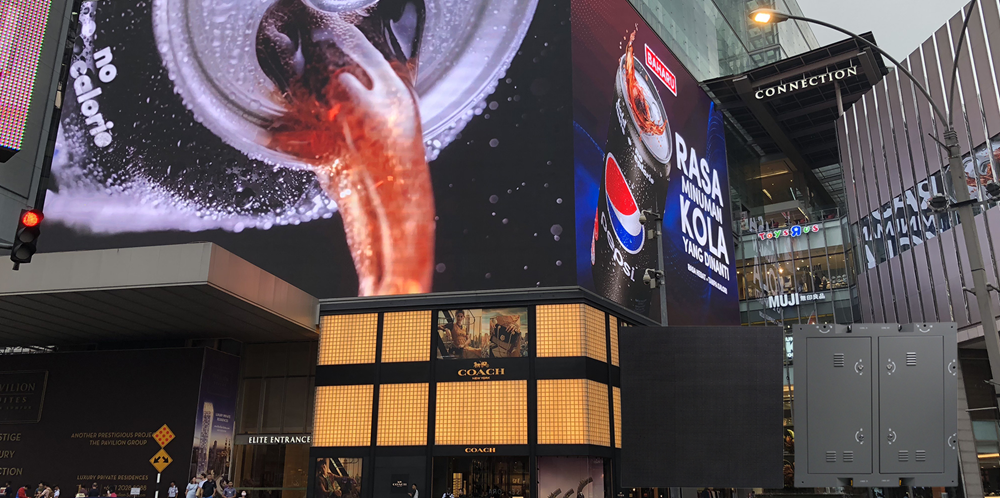
LED (Light Emitting Diode) displays are gradually becoming the new standard for indoor and outdoor video displays. You can see these high-brightness screens in many retail environments, and they are also increasingly appearing in commercial spaces, delivering high-quality and impressive image performance.
Although projectors still play an important role in display technology, LED products are becoming an attractive alternative. Thanks to new all-in-one displays introduced by manufacturers such as ViewSonic, LED solutions are gaining popularity by offering greater flexibility for displaying images in indoor spaces.
If you are curious about LED displays and the benefits they offer, we have compiled a guide that includes everything you need to know.
What Is an LED Display?
LED video displays use LED panels to generate images. This differs from LCD (Liquid Crystal Display) screens, which sometimes use LEDs as a backlight but not to produce the image itself.
LED displays can create ultra-high brightness screens, making them ideal for environments with varying lighting conditions—whether under direct sunlight or near strong artificial lighting. These displays are often made up of multiple interconnected panels that can produce stunning visuals at impressive sizes, making them ideal for a wide range of applications, including:
-
Commercial retail spaces
-
Events and festivals
-
Commercial digital signage
-
Digital advertising
-
Educational institutions
-
Art galleries and museums
How Large Can LED Displays Be?
The size of an LED display depends on the number of panels installed. While the size of an individual panel may vary by manufacturer and product, multiple panels can be combined to create large LED walls. This results in a seamless video surface whose size and shape are almost unlimited.
Think about the massive video walls used for headline performances at music festivals—this gives you a sense of the scale LED displays can achieve.
When discussing LED display sizes, we usually think of them as “large,” but exactly how large depends entirely on your specific needs. Professional LED display specialists can help calculate the appropriate size when planning your LED configuration.
Types of LED Walls
Not all LED displays are the same. Depending on your application, there are several product types available. These generally fall into three main categories:
Outdoor LED Technology
Outdoor LED panels are designed with weather-resistant structures that allow them to operate even in rain or under direct sunlight. If you are organizing a festival, sporting event, or large outdoor party, an outdoor LED wall may be the ideal solution.
Indoor LED Technology
Indoor LED video panels are typically viewed from a closer distance, so their resolution is usually much higher than outdoor versions. These displays are ideal for press conferences, PR events, indoor retail environments, places of worship, or office meeting rooms.
Portable LED Technology
Portable LED displays are designed for flexibility and mobility, making them suitable for temporary installations, touring events, and rental applications.
Modular LED Panels
LED panels are modular in design. This means you can configure the size and aspect ratio depending on how the panels are arranged. Mobile LED panels are often preconfigured to display specific content. However, if you choose to create a custom LED wall, you can design virtually any shape and layout without limitation.
With LED wall panels, you gain greater flexibility and creativity when configuring visual displays. Depending on the environment, you can create rectangular layouts, pyramid shapes, or other unique configurations.
Of course, this flexibility can also introduce challenges when setting the correct aspect ratio for your content. While you can build impressive configurations, you should consider the type of content you plan to display from the beginning to ensure everything fits perfectly.
How Is LED Video Display Technology Different from Projectors?
First, LED panels are typically much brighter than projectors and professional displays. Because LED panels generate their own light, they can produce extremely vivid and realistic visuals on large screens. Unlike projectors, LED panels do not lose brightness over time and can maintain high saturation and contrast even after years of use.
The scalability of LED displays is both an advantage and a disadvantage. Individual LED panels typically range from about 60 inches to 90 inches, but when multiple panels are combined, the display size can expand almost indefinitely. However, if such a large display is required, LED systems can be significantly more expensive than standard projectors or professional monitors. Their advantages become most apparent when large-scale displays are needed.
Similarly, if you need to display images in a small room, a projector or large professional monitor may sometimes be more suitable.
Although LED panels often require a higher initial investment, the overall cost may be lower because LED systems generally require minimal maintenance or replacement. Once installed, LED video panels can deliver high-quality images for much longer than most projectors. Depending on the model, they may also consume less energy during operation, reducing long-term operating costs.
If you are deciding between LED displays, professional LCD displays, and projectors, feel free to contact our LED display experts. We would be happy to discuss the best configuration based on your needs and budget.
LED Display Resolution
Pixel Pitch
An effective way to measure the image resolution of an LED video wall is pixel pitch, also known as dot pitch. Pixel pitch refers to the distance between the centers of two adjacent pixels, measured in millimeters.
The smaller the distance between these points, the higher the pixel density. This means a higher image resolution can be achieved within the same display area. For example, if a panel has a pixel pitch of 5.5 mm, the display is referred to as having a 5.5 mm pixel pitch.
The more pixels an image contains, the richer the details become, resulting in sharper and clearer visuals—especially when viewers are closer to the screen. Currently, the smallest pixel pitch available is around 0.75 mm.
Viewing Distance
Pixel pitch is closely related to the optimal viewing distance of an LED display. If viewers stand very close to an LED screen, they may be able to see individual pixels and the gaps between them, which is not ideal. Therefore, the display configuration should match the distance between the audience and the screen.
If an LED display has a larger pixel pitch (which means relatively lower resolution), viewers need to stand farther away to achieve a clear image. This can be ideal for large-area viewing scenarios. Conversely, if viewers are close to the screen, a smaller pixel pitch is required to maintain a clear image—even at short viewing distances. This is often referred to as small-pitch display technology.
If you want to determine the best configuration for your needs, we would be happy to calculate it for you. As a rough estimate, a common rule is:
Post time: Mar-16-2026