
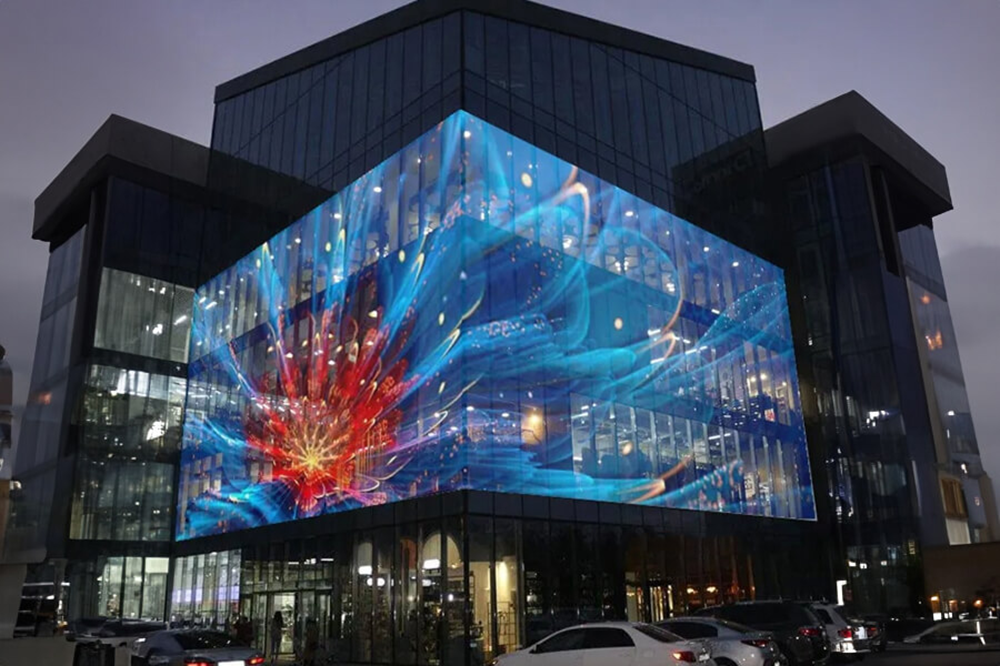
In recent years, transparent LED screens have opened up new possibilities for visual communication for businesses and event organizers. They can display vivid images while maintaining high visibility.
Let’s take a closer look at five creative applications where transparent LED screens are making an impact.
Shopping Malls and Retail Stores
In shopping malls, traditional window displays often require a compromise between indoor visibility and external aesthetics. Transparent LED screens solve this problem cleverly. They can play videos, promotional messages, or brand content without blocking the view inside. As a result, retail windows and building facades are transformed into vibrant and eye-catching display spaces.
Stage Design and Live Events
Transparent LED walls are also widely used for concerts, festivals, and television programs. They can be placed in front of lighting equipment or performers without blocking light or sightlines. The result is a stage that can appear open and spacious one moment and create a fully immersive experience the next.
Exhibition Halls and Trade Shows
Success in exhibition halls depends heavily on visual impact, as exhibitors compete to stand out. Transparent LED video walls make this possible by turning building facades, booth partitions, and digital signage into dynamic visual experiences. They can display promotional videos, product demonstrations, or real-time data while maintaining clear visibility of the exhibits and people inside.
Subway Advertising and Information Displays
Subways have extremely high passenger traffic, offering huge potential for effective digital signage. Transparent LED screens are gradually replacing traditional posters and opaque displays. Installed on glass walls, ticket counters, or platform doors, they can deliver real-time information and advertisements without obstructing passengers’ views or affecting safety.
Airports and Transportation Hubs
At airports and transportation hubs, transparent LED video walls can be installed on building facades, boarding gates, or terminal corridors to display flight information, welcome messages, and brand content. Thanks to their high transparency, they integrate seamlessly with glass architecture, allowing passengers to enjoy vivid digital visuals without disrupting the overall design.
Behind these diverse applications is the Hot Electronics Transparent LED Screen Series, a highly adaptable transparent LED display solution that combines creativity with practicality.
With over 60% transparency, the Hot Electronics transparent LED screen maintains clear sightlines and natural lighting, transforming glass curtain walls, stage backdrops, or exhibition partitions into dynamic digital canvases.
Its lightweight and ultra-thin design allows for easy installation on glass walls or suspended frames without the need for heavy steel structures.
With brightness up to 8000 nits and a 3840 Hz refresh rate, it delivers vivid, flicker-free visuals, while the front-service module design simplifies maintenance in busy commercial or event environments.
Conclusion
As cities become smarter and spaces more interconnected, the demand for digital displays that combine visual appeal with practical functionality continues to grow. Transparent LED screens are redefining how we communicate through architecture, advertising, and design. With innovative technologies like the Hot Electronics Transparent LED Screen, the future of visual storytelling is not only bright—but also remarkably transparent.
Post time: Mar-10-2026