
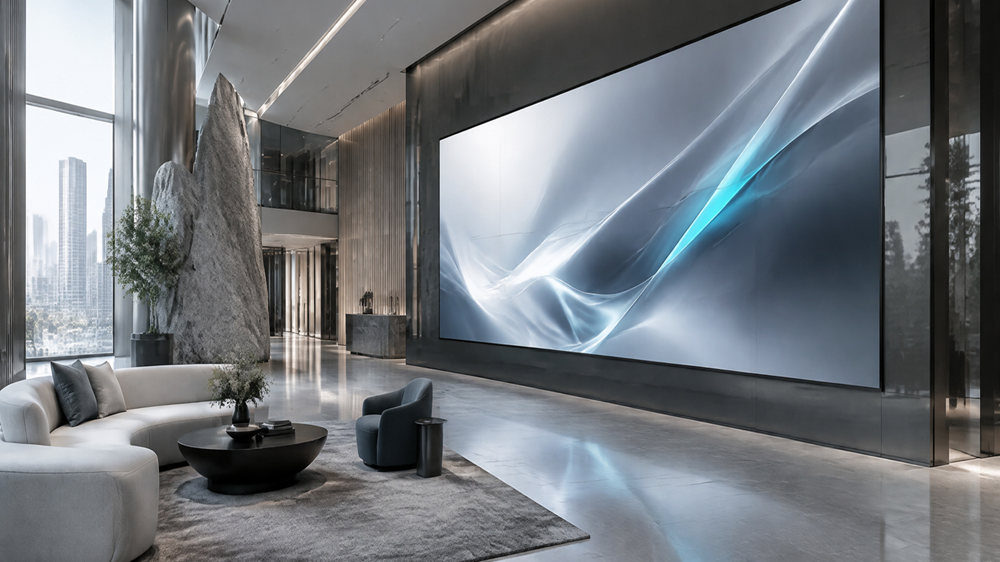
Indoor LED displays have become a standard choice for commercial signage, corporate communications, and event visuals. Whether you are looking for an indoor LED advertising screen for a retail store or a video wall for a conference room, the wide range of options can be overwhelming. This guide covers everything you need to know—from how indoor LED displays work and how much they cost to how to choose the right display for your space.
What Are Indoor LED Displays and How Do They Work?
The Basic Technology Behind Indoor LED Screens
Indoor LED displays consist of thousands of tiny light-emitting diodes arranged in pixel clusters on modular panels. Each pixel contains red, green, and blue LEDs, which combine to produce full-color images.
The two main chip technologies you will encounter are SMD (Surface-Mounted Device) and COB (Chip-on-Board). SMD is currently the industry standard and offers excellent cost efficiency for medium- and large-scale applications. COB is a newer technology that embeds LEDs directly onto the circuit board, providing better surface protection, finer pixel pitches, and improved visual comfort. This makes COB a preferred choice for premium environments where viewers are close to the screen.
Generally:
For close viewing distances (within 2 meters), such as control rooms or high-end corporate lobbies, COB technology is recommended. It supports P0.9–P1.5 pixel pitches, offers impact-resistant surfaces, and delivers excellent black contrast for improved visual comfort.
For larger commercial spaces and auditoriums (2–5 meters or more), SMD technology provides the best balance between image quality and cost, making it an excellent seamless alternative to traditional LCD video walls.
Indoor LED Displays vs. LCD Video Walls and Projection Systems
When comparing different display technologies, indoor LED displays offer the following characteristics:
| Feature | Indoor LED Display | LCD Video Wall | Projector |
|---|---|---|---|
| Seamless Image | Completely seamless, no bezels | Visible bezels between panels | Single image, but size is limited |
| Brightness | Typically 600–800 nits indoors; low-brightness grayscale performance is more important for image quality | 300–700 nits | 2,000–5,000 lumens, depending on ambient light |
| Scalability | Any size through modular panels | Limited by panel count and bezels | Limited by throw distance |
| Lifespan | 50,000–100,000 hours | 30,000–60,000 hours | 3,000–20,000 hours, depending on lamp type |
| Maintenance | Module-level replacement | Full-panel replacement | Lamp and filter replacement |
For most commercial indoor environments, LED displays offer advantages over LCD displays and projectors in terms of image quality, scalability, and long-term reliability.
One important specification to understand before purchasing is brightness. Indoor brightness is often exaggerated in marketing materials. A 1,500-nit screen in a conference room can cause eye fatigue, while most indoor environments only require around 600–800 nits.
The real technical difference lies in high grayscale performance at low brightness. A high-quality display can maintain rich color depth and contrast even when brightness is reduced. Lower-quality displays may simply become dimmer while losing detail, resulting in a washed-out image. A well-designed display maintains full grayscale performance even at lower brightness levels. This is something buyers should ask suppliers to demonstrate before making a purchase.
Applications of Indoor LED Displays
Indoor LED displays can be found in retail stores, corporate lobbies, conference rooms, control rooms, broadcast studios, event stages, houses of worship, transportation hubs, and more.
Large indoor digital advertising screens in shopping malls and airports are among the fastest-growing applications, replacing static signage with dynamic and eye-catching content.
What Types of Indoor LED Displays Are Available?
Fixed Installation vs. Rental LED Displays
Fixed-installation LED displays are designed for long-term use in locations such as retail stores, lobbies, and conference rooms. Rental LED displays, on the other hand, are designed for events, trade shows, and concerts, with lightweight construction and quick assembly for easy transportation, installation, and reconfiguration.
Traditionally, fixed-installation cabinets were considered heavier and bulkier than rental cabinets. However, this is gradually changing. Advances in cabinet materials—particularly the use of magnesium alloy structures—have reduced the weight of fixed-installation cabinets to around 7.5 kg per cabinet, comparable to many rental cabinets.
For buyers, this is about more than installation convenience. Lightweight fixed-installation cabinets can reduce the load on wall- and ceiling-mounted structures, provide more installation options in spaces that might otherwise require structural reinforcement, and significantly reduce installation labor costs.
If weight or installation complexity has previously been a concern, today’s cabinet specifications are worth reconsidering when evaluating whether a fixed-installation display can meet your structural and logistical requirements.
Standard Panels vs. Flexible LED Displays
Standard rigid LED displays are suitable for flat surfaces and conventional installations. However, if your design requires curves, columns, or other unconventional shapes, flexible LED displays may be the better choice.
Flexible displays can adapt to concave, convex, cylindrical, and other irregular surfaces. Although they typically cost more per square meter, they offer installation possibilities that rigid displays cannot achieve.
If you are considering a flexible LED display, make sure its flexibility and bending radius meet the requirements of your specific application.
Fine Pixel Pitch vs. Standard Pixel Pitch
Pixel pitch refers to the distance between LED clusters. It determines display resolution and should be selected based on viewing distance.
Fine-pitch displays provide sharper images at close viewing distances and are ideal for applications such as conference rooms and control rooms. Standard-pitch displays are generally more suitable for larger viewing areas or longer viewing distances.
Fine-pitch displays are significantly more expensive than standard-pitch displays, so selecting the appropriate pitch is an important part of managing project costs.
What Key Features Should an Indoor LED Display Have?
Pixel Pitch and Resolution
This is one of the most important specifications. Pixel pitch should match your minimum viewing distance. As a general rule, the pixel pitch in millimeters roughly corresponds to the minimum comfortable viewing distance in meters.
For example:
- P1.5 works well at around 5 feet (1.5 meters), making it suitable for control rooms and executive conference rooms.
- P2.5 performs well at around 8 feet (2.5 meters), making it suitable for conference rooms and retail signage.
- P4 provides a comfortable viewing experience from around 13 feet (4 meters), making it suitable for lobbies, auditoriums, and large open spaces.
Choosing a higher resolution than your viewing distance requires will increase costs without necessarily producing a noticeable improvement in image quality.
When in doubt, measure your actual minimum viewing distance before requesting quotations. It is one of the most direct factors determining your final investment.
Brightness, Contrast, and Refresh Rate
For indoor environments, 600–800 nits is generally sufficient for a comfortable viewing experience.
For refresh rate, 3,840 Hz or higher is recommended and has become a common standard for indoor LED displays. At this level, moiré patterns and scan lines are significantly reduced when the screen is captured by cameras.
Displays with lower refresh rates should be evaluated carefully, particularly for applications involving video recording, live streaming, or broadcast production.
Cabinet Design and Maintainability
If your screen will be installed directly against a wall, consider a front-serviceable cabinet. Tool-free module replacement can significantly speed up maintenance.
For installations where rear access is limited, ultra-slim cabinets are becoming increasingly popular. Cabinets below 100 mm in thickness are common in the industry, while leading models such as the C-Max series can be as thin as 70 mm, making them ideal for compact wall-mounted installations.
How Much Do Indoor LED Displays Cost?
Key Factors Affecting Pricing
The price of an indoor LED display mainly depends on pixel pitch, screen size, cabinet quality, and brand.
The smaller the pixel pitch, the higher the price per square meter and per cabinet. This is particularly important when comparing quotations because suppliers may use different pricing methods, such as pricing by screen area or by the number of cabinets.
Larger screens naturally have higher total costs. Premium brands generally cost more but may provide better color consistency, reliability, and after-sales support.
Typical Price Ranges by Application
The following ranges can be used as a general budgeting reference:
| Application | Typical Size | Estimated Cost Range |
|---|---|---|
| Small Conference Room Display | 2–4 m² | $5,000–$20,000 |
| Medium Retail Signage | 5–10 m² | $15,000–$50,000 |
| Large Indoor Video Wall / Billboard | 15–30+ m² | $50,000–$200,000+ |
These prices generally cover the display hardware but may not include installation, control systems, or structural engineering.
Always request a detailed quotation from your supplier so you can clearly understand what is included.
Total Cost of Ownership
The purchase price is only the starting point. You should also consider installation labor, mounting structures, video processors and control systems, power consumption, spare modules, and ongoing content management.
In terms of power consumption, indoor LED displays typically have an average real-world power consumption of around 180 W/m² during operation. This figure is more useful for estimating long-term energy costs than maximum rated power.
When comparing indoor LED displays from different suppliers, total cost of ownership (TCO) can provide a more accurate picture of long-term value than the initial purchase price alone.
What Are the Pros and Cons of Indoor LED Displays?
Advantages Compared with Other Display Technologies
Modern high-quality indoor LED cabinets—especially those made with magnesium alloy or die-cast aluminum—can use the cabinet itself as a natural heat sink, eliminating the need for fans. This fanless design helps address thermal management in wall-mounted and enclosed installations while providing silent operation for conference rooms and corporate environments.
Indoor LED displays can deliver completely seamless images at virtually any size, without bezels or visible gaps.
They provide high brightness and excellent color accuracy even in well-lit indoor environments.
Modular construction makes it easy to scale the screen or replace individual components without affecting the rest of the display.
They typically have a rated lifespan of 50,000–100,000 hours, generally measured until brightness drops to around 50% of the original output, which is significantly longer than many LCD panels and projectors.
Energy efficiency has improved significantly in recent years, helping reduce long-term operating costs.
Limitations and Trade-Offs
Higher upfront costs compared with LCD video walls or projectors, especially when using fine-pitch displays.
Fine-pitch panels can be expensive when close viewing distances require high pixel density to avoid visible pixelation.
Content management systems can add complexity and cost compared with simply connecting a display using an HDMI cable.
How to Choose the Right Indoor LED Display for Your Project
Match Pixel Pitch to Viewing Distance
Choosing the right pixel pitch is one of the most critical decisions in any indoor LED project.
Use the pixel-pitch and viewing-distance guidelines above as a starting point, and determine your actual minimum viewing distance before requesting quotations from suppliers.
Adjust Screen Size to Your Space
Consider the available installation area. A screen that is too small may reduce visual impact, while a screen that is too large can make the space feel crowded.
Most professional suppliers can help determine the ideal screen size based on your space dimensions, viewing distance, and application requirements.
Evaluate the Supplier Before Purchasing
Ask about warranty terms, spare-parts availability, technical support, and after-sales service. You should also review reference projects that are similar to yours.
A professional supplier should be able to conduct a site survey before providing a quotation and should evaluate your specific requirements rather than simply recommending a display without understanding the project.
Indoor LED Display Trends to Watch
Micro-LED and Mini-LED Display Technologies
Micro-LED and Mini-LED technologies are creating new opportunities for indoor LED displays with pixel pitches as fine as P1.0 and below.
This allows indoor LED displays to compete with high-end professional displays in applications where viewers are positioned very close to the screen.
Interactive and Smart LED Displays
LED displays are becoming increasingly common in retail environments, particularly for interactive and touch-enabled applications.
These displays can also be integrated with smart technologies to deliver dynamic content and adapt displayed information based on different audiences and usage scenarios.
Transparent and Creative LED Displays
Transparent LED displays can display digital content while allowing light to pass through the screen. This technology is particularly popular for retail storefronts and window displays.
Creative-shaped LED displays are also becoming increasingly popular, allowing designers to create curved, irregular, and customized visual installations.
Find the Right Indoor LED Display for Your Space
Choosing the right indoor LED display screen comes down to matching the pixel pitch, screen size, and features to your specific environment, application, and budget.
Do not compare displays based on price alone. Consider the total cost of ownership, supplier support, installation requirements, and long-term reliability.
Start by determining your viewing distance and application scenario. Then request detailed quotations from reputable suppliers and compare the technical specifications, service capabilities, and total project costs to find the solution that best fits your project.
Post time: Sep-17-2026